
Should You Pour Concrete Before Ordering a Metal Building?


In most cases, our advice is to understand your permit requirements and the full project cost first, then order your metal building before pouring concrete. You can lock in your agreed building price while the site is prepared, and you avoid pouring a slab for a building whose details aren't settled. But pouring first isn't automatically wrong—especially if you already have an approved, suitable slab.
Here's how we help customers decide at Ridgeline Structures.
First, find out what your local permitting office requires
Before we encourage anyone to place an order, we ask whether they've spoken with their local permitting authority. Does the planned garage need a permit? Engineered building drawings? A foundation plan or inspections? The answer depends on the location and intended use.
We won't push someone to order a building just to obtain engineered drawings they may not need. But if engineered drawings are required, the manufacturer typically won't commission them without a building order. That can create financial risk if the customer hasn't yet clarified what their local office will accept. Resolve as much of that uncertainty as possible before paying a deposit.
Next, price the whole project—and consider securing the building price
Get a realistic picture of the building, concrete, site preparation and any permitting-related expenses. Then, once you know what you're buying, there can be a financial advantage to ordering the building before the site is finished. Steel prices are unpredictable, and delaying an order for several months could mean paying more.
We can generally coordinate an installation hold of three to six months, subject to manufacturer and order terms, which gives customers time to get the property ready without automatically losing the building price they agreed to. Ordering early is not the same as rushing installation.
Before you pour, settle the concrete dimensions and details
One of our most common customer questions is how big to make the slab. As a general starting point, the concrete footprint should match the building dimensions: a 24 × 30-foot garage typically calls for a slab planned around that same footprint. Confirm the exact dimensions and the manufacturer's anchoring requirements with the concrete contractor before forming the slab.
We also prefer a notched lip, or drip ledge, where appropriate. That allows the siding to extend past the base rail and overlap the recessed concrete edge, helping limit water and pest entry. The final notch and edge configuration should follow the details for the selected building.
Our typical residential concrete package is a 4-inch slab with residential fiber reinforcement, a 12 × 12-inch thickened perimeter edge and 3,500 PSI concrete. Heavier equipment or unusual loads may call for reinforcement, greater thickness or other changes; in those cases we rely on our concrete partner and, where needed, engineered specifications. This is our standard offering, not a universal requirement for every site.
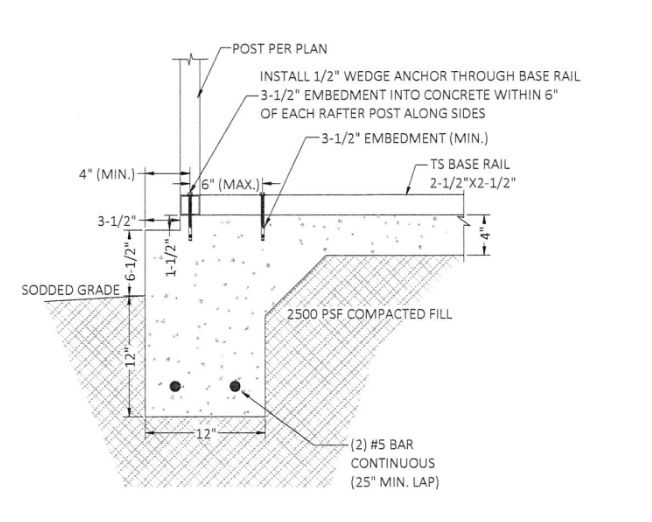
Example engineered base-rail anchorage and footing detail. Follow the plans and local requirements for your actual project.
What if your slab is already poured?
That's not necessarily a problem. If required permits and inspections are complete, an existing suitable slab can be an advantage: we can let the manufacturer know at order submission that the site may be ready for installation scheduling. Where permits aren't required, we begin by checking dimensions, levelness and clearance, along with compatibility with the selected building and its required anchoring.
When Ridgeline coordinates both the concrete and building, we follow the concrete order through completion. Once we receive site photos documenting the finished slab, we submit those to the manufacturer and move the order into installation scheduling, subject to any additional readiness requirements.
Our bottom line
Don't pour before you know what building you're buying, and don't order before understanding your permit requirements and overall budget. Once those questions are settled, we generally favor ordering the building first and using the installation lead time to complete site work. If you've already poured a suitable slab, you may simply be ready to move faster.
Want help planning the sequence? Request a building quote or explore our concrete services.


Comments